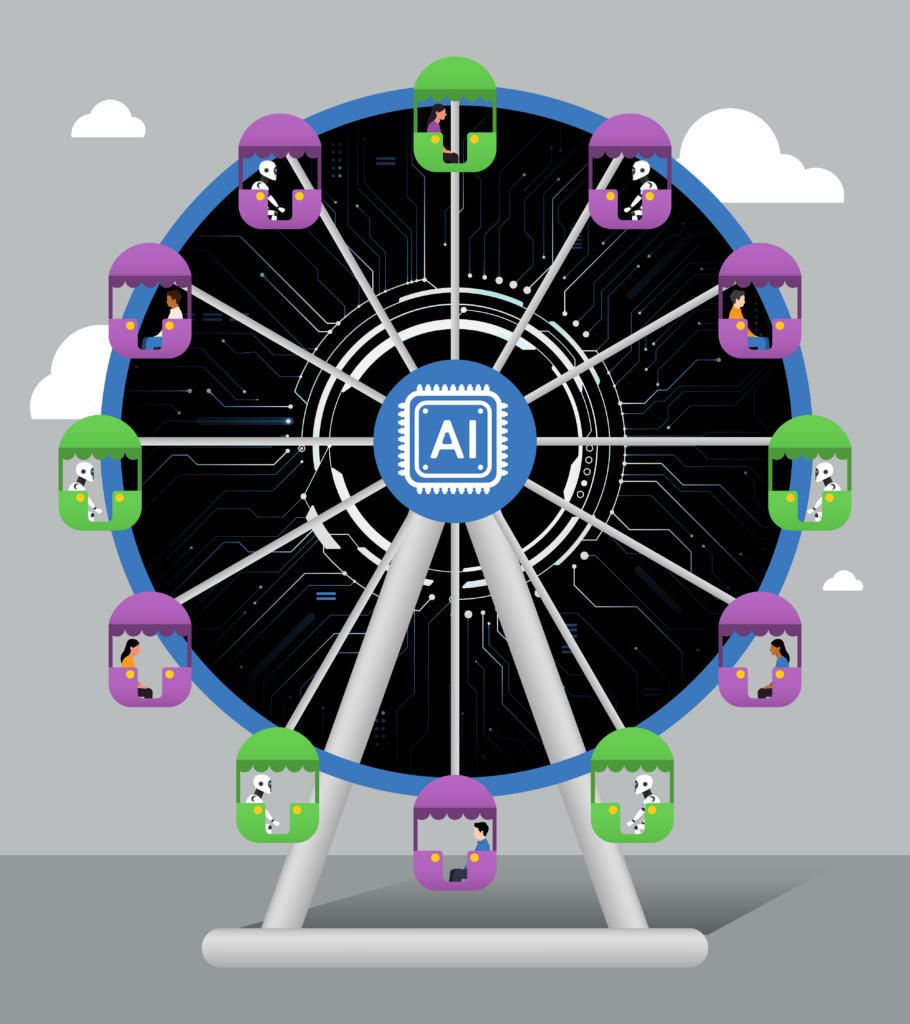
- Integrating humans into automated AI processes helps avoid costly errors.
- Reserving humans for high-impact decision-making can create new challenges.
- By positioning AI tools as assistants rather than replacements, organizations can increase internal tool adoption and maximize the value of AI.
The rapid adoption of AI tools and agents in the workplace has caused no small amount of concern among human workers. One recent poll shows that 53% of Americans worry that AI could put them or someone in their household out of work.1
Should we worry? There’s no doubt that AI tools promise to relieve humans of some of our more mundane, tedious tasks. And across industries, organizations are already using AI to boost efficiency of numerous processes—from handling insurance claims and streamlining loan underwriting to optimizing trucking routes and managing complicated document reviews.
But for many AI-powered processes, keeping a “human in the loop” is vital. A human should review key automated decisions, approving them when they are correct and fixing them when they are wrong.
For years, this human-in-the-loop (HITL) concept was referenced mostly in academic papers on machine learning. Today, it is becoming an operational reality for any organization implementing AI, especially when they use AI for automated processes. The stakes could not be higher.
The Shift Underway—and the Risks It Is Creating
Organizations are not just adopting AI. They are rebuilding around it.
In multiple sectors, organizations are restructuring workflows, redefining employee roles, and reorienting decision-making around AI systems. One immediate result is that a smaller number of humans are touching consequential decisions.
That might not be a problem if AI systems made all the right decisions. But (at least for now) AI models and agents are prone to errors.
Let’s say a manufacturer has built an AI agent to streamline procurement of parts. The agent is designed to find the lowest cost for a particular widget and order it, automatically. It might find a low-cost widget overseas but fail to recognize that import tariffs ultimately make that widget more expensive than parts sourced from elsewhere. The error can result in monetary losses and manufacturing delays.
AI-assisted software development is another area where serious problems can emerge in the absence of human oversight. An AI development tool might create code that looks good at first glance and even passes syntactical checks. But the tool might arbitrarily reference an old library that can’t handle production-scale traffic, causing the app to crash. Or the tool might unknowingly introduce a security vulnerability.
These types of issues can appear in any process where AI completely automates processes. And the potential consequences in fields like law, financial services, and medicine could be even more dire.
Inserting Humans into the Loop
Until AI systems can make flawless decisions and deliver error-free results, organization must insert humans into the loop. According to a recent survey of business leaders, 81% of respondents expect AI agents to make impactful decisions for their organizations in the next year—but today, only 25% completely trust AI systems to operate without human oversight.2
The challenge is to balance the efficiency of the AI workflow with this necessary governance from humans. You don’t want to insert a human into every step of the workflow—just the points where there are critical opportunities to correct problems or finalize decisions.
Consider a few examples of where humans can be integrated into AI-powered processes:
- Customer relationship management (CRM): An AI tool can handle many CRM tasks autonomously—such as providing first-line customer support, answering product questions from new leads, and writing follow-up emails. But human reps can then review AI-generated actions and close deals with prospects.
- Loan applications: A bank might use an AI tool to evaluate credit risks and draft legal documents for new loan applicants. Analysts can then assess loan recommendations, and lawyers can review all documents before they are sent out.
- Healthcare diagnostics: Medical practices increasingly employ AI tools to quickly evaluate patient scans, helping to triage emergencies and spot hidden anomalies. Clinicians then prioritize the evaluation of scans that the AI tools have flagged. Humans, not AI models, make the final diagnoses.
Inserting humans in these and other processes can go a long way toward reducing risks. Still, the HITL approach is not without its own challenges.
The Challenges of Integrating Humans and AI
Reserving human intervention for critical moments of AI-driven processes should reduce burdens on humans. The AI tools do all the tedious work, and the humans can save their brainpower for consequential decisions. But there are a few problems.
First, AI tools dramatically accelerate all that tedious work. That’s great: They can scale output very efficiently. However, the humans in the loop need to keep up. You might be spared the first five steps in a process, but if the sixth step now occurs much more frequently, you could easily fall behind. The AI benefits of scale and efficiency evaporate as the queue for human decisions lengthens.
Second, all of those human decisions become more consequential. Before AI was part of the workflow, humans made numerous small decisions every day and completed a variety of mundane tasks that might have even served as brief mental breaks. Now those breaks are gone. You might have to make one important decision after the next, which can be stressful and tiring.
Finally, these decisions might require higher skill levels—or at least different skills. Why? AI systems produce outputs with great confidence. They don’t typically flag their own blind spots or hesitate when they are potentially wrong. The human reviewing an AI recommendation must have enough expertise to catch errors—even errors that are presented in an extremely authoritative way.
These challenges can be addressed in part by finding the right humans and applying the right training. The best human-in-the-loop workers should be able to:
- Move fast, evaluating large volumes of AI-generated work without sacrificing quality, accuracy, or compliance
- Handle the strain of near-continuous, high-impact decision-making—and carry the accountability for those decisions
- Know when to challenge AI output, based on their deep domain knowledge
- Understand how to optimize AI by fine-tuning agents, refining prompts, and recalibrating models when output is frequently incorrect
Adding Assistants Instead of Fearing Replacements
There’s no question that some tasks previously handled by humans will now be handled by AI. AI tools and agents can help organizations drastically increase the speed, scale, and efficiency of many previously manual, time-consuming tasks.
For many use cases, though, humans should remain part of the process. Establishing human oversight for AI-powered workflows enables organizations to avoid costly errors.
At the same time, adopting the HITL approach can reduce employees’ anxiety of being replaced by AI—and that will ultimately help organizations to maximize the value of AI. When employees see AI tools as their assistants rather than their possible replacements, they are more likely to adopt the tools and explore new ways to use them for innovation.
A: A human-in-the-loop (HITL) approach integrates humans into automated AI processes to review and then approve or correct key decisions. The human acts as a guardrail for AI tools and agents, helping to ensure quality control, compliance, and accuracy.
A: While AI can accelerate and scale processes, current models and agents are still prone to errors. Without human oversight, AI can make mistakes that result in monetary losses, introduce security vulnerabilities, and even jeopardize human health.
A: Humans must keep up with the speed of AI-driven processes. Constant focus on high-stakes decisions can result in stress and mental fatigue. And humans need the skills to detect errors, even when those errors are presented with extreme confidence.
A: Humans must move fast, handle the strains of continuous decision-making, have the deep domain expertise to instantly spot inaccuracies, and the knowledge of AI systems to help improve future outputs.
- Jason Lange and Courtney Rozen, Half of Americans fear AI could put someone in their household out of work, Reuters/Ipsos poll finds, Reuters, June 2026
- Kydryl, People Readiness Report 2026, June 2026
