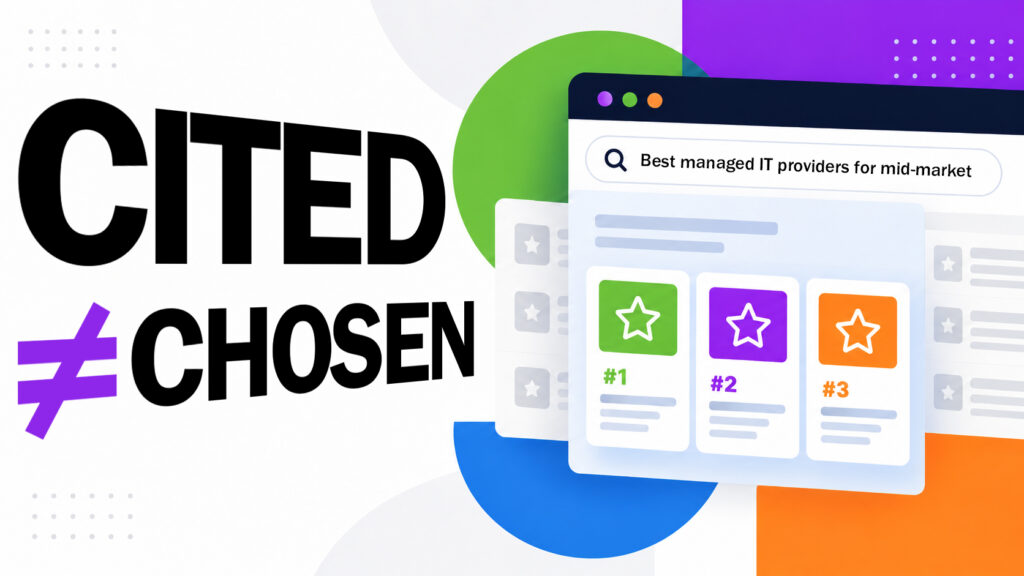
- B2B buyers increasingly use AI chatbots to explore vendors and products.
- While being mentioned in AI-generated responses is important for brands, it’s not enough to influence decisions.
- Earning recommendations from customers, analysts, and other third-party sources is critical to winning over buyers.
When your brand is mentioned in an AI-generated search response, it feels like a win. But unfortunately, just showing up isn’t enough.
As B2B buyers increasingly use AI chatbots and AI-enhanced search engines for vendor and product research, being cited is certainly important. Marketers, however, will need to build brand credibility and ultimately earn recommendations for their products to be considered.
Appearing in AI-Generated Responses
According to research from G2, 51% of B2B software buyers now start their research with an AI chatbot more often than a traditional search engine.1 Buyers are using these chatbots to find products and compare vendors.
Chatbots are not only changing how buyers find information, they are also influencing what buyers choose. G2 found that 69% of software buyers said information from an AI chatbot led them to choose a different vendor than originally planned.
For B2B marketers, this shift to AI-led product research creates new challenges. First, marketers have to make sure their brand and products show up in the right places. For example, you might need to ensure your company appears in results related to cybersecurity as well as cloud infrastructure and managed IT services.
The good news is that marketers have likely spent years optimizing their content so it will be found and referenced by search engines. Much of that work is still relevant in the AI era. Search engine optimization (SEO) provides a strong foundation for generative engine optimization (GEO).
Next, marketers must find ways for their products to make a shortlist for buyers. If a buyer asks an AI tool to recommend the three best providers for their specific needs, will your company make the cut?
Moving Beyond Visibility
When B2B buyers use AI chatbots, their first questions might focus on understanding a technology or identifying potential vendors. Subsequent questions become much more specific. They will ask which providers are best for a company of their size. And they will compare competing solutions, attempting to find important advantages and drawbacks for each possible solution.
If your company survives this level of scrutiny, there is still more ahead. For example, buyers might ask chatbots about what other customers have said about working with your business and your competitors. These buyers don’t just want the right tech specs; they want the assurance that potential vendors can deliver what they promise. That often means looking beyond what companies say about themselves.
Earning Third-Party Credibility
The role of independent validation can’t be overstated. According to G2 research, 45% of buyers said citations from software review sites were the most “confidence-inspiring” signal in AI-generated answers.2 As buyers home in on a particular vendor or solution, those third-party inputs are critical for finalizing decisions.
Buyers are looking for not only customer reviews but also independent research and industry perspectives. All of this information helps to shape how a brand is perceived.
While buyers might seek out that third-party input on their own, they are also (maybe not surprisingly) comfortable gathering citations from the AI chatbots they are already using. After all, AI chatbots have the ability to simplify the process for buyers, bringing multiple sources together in a single response.
For marketers, the challenge of earning third-party credibility is familiar. Marketers have long understood that customer case studies, video testimonials, independent reviews, mentions in analyst reports, and other forms of external validation are extremely valuable in giving prospects the confidence to move forward with sales. The challenge now is to make sure that marketing efforts are focusing on earning third-party recommendations that will be referenced in AI responses.
Progressing from Recognition to Recommendation
As B2B buyers rely more on AI chatbots and AI-enhanced searches to explore products, marketers must ensure that their brand and products appear—and are recommended—in AI responses. That work should be an evolution of more traditional efforts to increase brand visibility and third-party validation.
At the same time, marketers will need to refine how they measure brand presence in AI search. Citation counts and brand mentions are useful indicators of visibility, but they don’t tell the full story of how a company is being positioned against its competitors. Brand and product recommendations will be far more important indicators of whether marketers are poised to influence decisions.
A: B2B buyers are increasingly using AI chatbots to explore vendors and products. Research from G2 shows that 51% of B2B software buyers now start their research with an AI chatbot more often than a traditional search engine. AI responses not only provide information, they also influence buying decisions.
A: In response to shifting B2B buyer practices, marketers must first ensure their brand and products appear in AI-generated responses. But just as important, they must work to earn third-party recommendations from customers, analysts, and other external sources to make the shortlist for buyers.
A: No, changes in buyer behavior should not require completely new marketing strategies. Efforts to appear and be recommended in AI responses are an evolution of marketing work to increase brand visibility and third-party validation.
