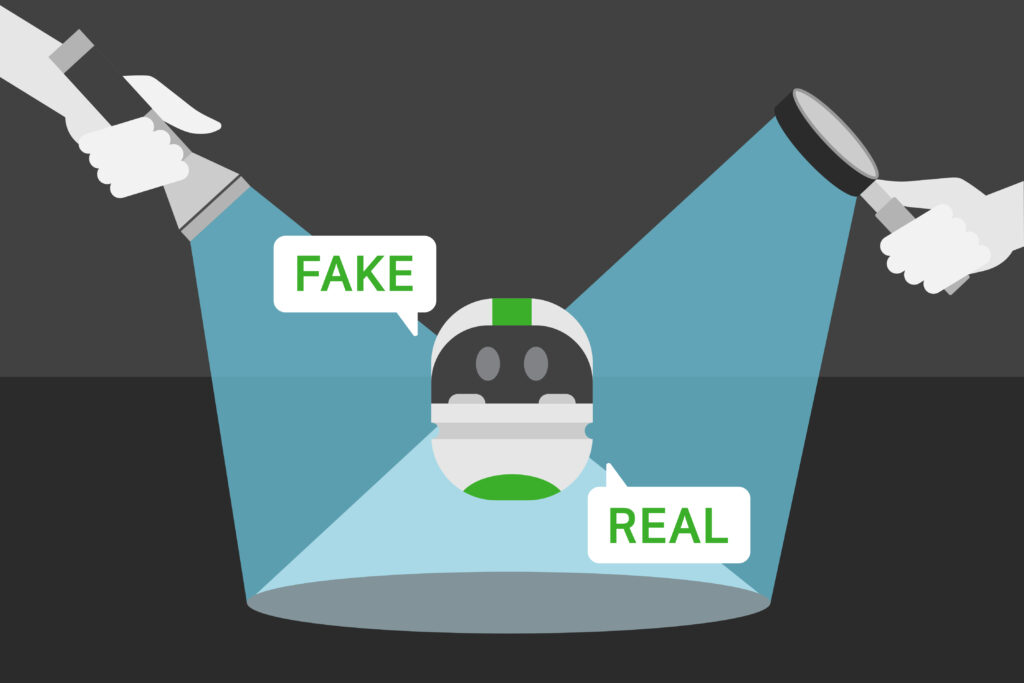
AI doesn’t lie, it hallucinates. And attackers can exploit this weakness. Organizations need to understand what hallucination is, what it means for cybersecurity, and how to approach it within their Security Operations Center (SOC). This understanding becomes critical as more organizations deploy AI in their security operations.
How AI Accuracy Training Creates False Confidence
AI hallucination occurs when language models provide answers that are plausible but false. One explanation from OpenAI put it this way:
“Think about it like a multiple-choice test. If you do not know the answer but take a wild guess, you might get lucky and be right. Leaving it blank guarantees a zero. In the same way, when models are graded only on accuracy, the percentage of questions they get exactly right, they are encouraged to guess rather than say ‘I don’t know.’”1
In addition to training based on “accuracy,” other common causes of hallucinations include incomplete or biased training sets and poorly worded or vague prompts. A recent study found that in certain legal-domain tasks, hallucination rates ranged from 17% to 33%.2 It’s important to understand that the current generation of AI is not guaranteed to be correct. If you have AI in use in your SOC, ensure that you understand how these hallucinations could be affecting you, your company, and your industry.
AI and Your SOC
As our adversaries improve their techniques and use AI to augment attacks, many organizations are also racing to implement AI-driven responses. SOCs collect more data than ever before, generating vast numbers of alerts. Analyst fatigue sets in when teams are overwhelmed by alert volume and false positives. AI tools can help, but when they hallucinate, they can make things worse, with analysts chasing false phantom alerts.
Another critical vector is synthetic data poisoning. Attackers introduce benign anomalies over time to retrain AI model baselines to mark malicious events as normal. This sophisticated technique, still under research, shows how a very small percentage of intentionally false data can compromise entire datasets.
To mitigate these risks, organizations are adopting practices such as:
- Maintaining a “frozen” baseline to compare against learned patterns
- Implementing out-of-band validation via deterministic systems
- Continuously tuning and retraining only with verified feedback loops
Many companies are enhancing their SOC capabilities with AI-augmented tools, but without proper guardrails, those tools can be exploited by the very threats they were designed to stop.
(Author’s note: While researching this section, a popular AI chatbot fabricated a realistic-sounding citation about Microsoft and the University of Toronto studying model poisoning. The paper doesn’t exist—a perfect example of an AI hallucination in action.)
AI Is a Tool, Not Magic
Would you replace a team of 20 shovel-carrying workers with an excavator and no crew? The excavator digs faster, but you wouldn’t remove the entire crew. You still need trained personnel and safety protocols. The same is true for AI in SOCs.
AI tools show strong potential to reduce noise, lower false positives, and strengthen security posture. But no tool is a “magic bullet” to solve all your needs. A well-designed cybersecurity solution integrates AI with the organizational environment, guardrails, documentation, and training.
Organizations deploying AI security solutions need to be aware of limitations such as hallucination. Most importantly, they must keep humans in the validation loop. AI should augment human judgement, not replace it.
- OpenAI, Why language models hallucinate, September 2025
- Journal of Empirical Legal Studies, Hallucination-Free? Assessing the Reliability of Leading AI Legal Research Tools, March 2025
