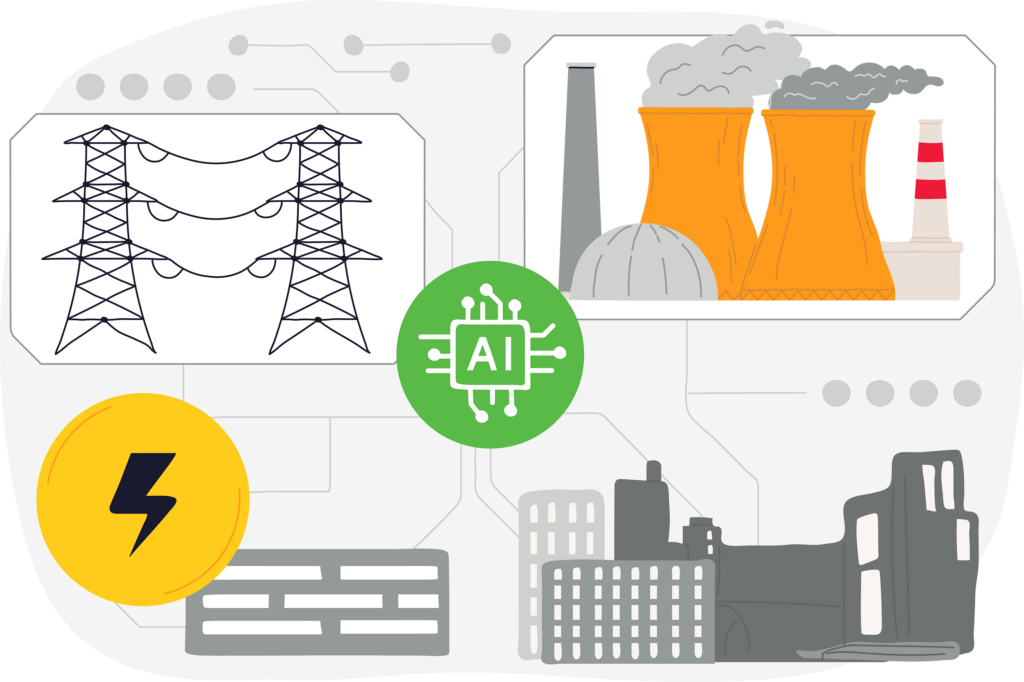
- AI scalability is now constrained by energy availability, not only compute.
- AI costs are increasingly tied to electricity markets, grid stress, and regional demands.
- Vendors can win over customers by offering predictable, energy-efficient, and flexible AI.
When a Virginia data center went offline for 90 minutes last summer amid a heatwave, it wasn’t an outage or a security breach. Rather, the grid simply couldn’t deliver enough power. That week, inferences that had been routed through Virginia saw costs spike 40% for AI vendors, but most never saw it coming because the energy line item was invisible in their cloud bills.1
Physics Becomes a Pricing Challenge
As AI adoption continues to accelerate, the industry faces a resource that isn’t getting much media attention: electricity. Hyperscale data centers are using grid capacity so quickly that they outpace construction efforts to add more of it. Projected AI data center demand in 2030 is 945 TWh, more than double usage in 2024.2 One viable solution, small modular nuclear reactors, takes two to four years to build, but most of those are still in the contract phase.
For any AI feature, this means that gross profit is now dependent on someone else procuring energy, and that cost to serve can change in the blink of an eye if there’s some delay in power resources. As grid stress increases during heat waves, transmission line failure, or peak seasonal demand, what’s the real cost underlying AI operations, even when code remains the same.
Three Forces at Work on the New AI Economics
- Grid scarcity: Hyperscale elasticity is no longer assured. AWS, Azure, and Google plan to spend roughly $240 billion a year on land, data centers, silicon, and power contracts. They’re securing Power Purchase Agreements years in advance. Amazon recently locked up 1,920 megawatts of nuclear energy through 2042.3 They’re buying resources that don’t exist yet.
- Cost volatility: Shadow-pricing is the variable no one talks about because it doesn’t show up on the P&L. Inferences are priced relative to power supply and demand. In 2025, wholesale electricity near US data hubs cost up to 267% more than in 2020.
- When the platform is constrained by power, your AI is constrained by the same power limitation.
- Regulatory expansion: In Europe, the new EU AI Act and NIS2 are tied to physical location; the AI has to execute in a certain place, impacting where and how inference can be done. That puts stress on top of already constrained grid regions.
The sum of those forces, energy availability and location, adds up to the new AI product strategy.
From the Feature Race to Risk Reduction
Enterprises are becoming savvy buyers. Leaders don’t just ask if a model is accurate. They also ask:
- What is my AI OpEx predictability?
- What are my locality’s constraints?
- What is your plan for regional grid stress?
- What is the energy cost per inference unit?
Power has become a variable in procurement. Companies that reduce exposure through efficient model design, placement control, and transparency are the lowest-risk choice for risk committees. They are easier to sign off on in security reviews. They’re easier to budget for in multiyear spend. Accuracy is table stakes. Predictability is the differentiator.
Five Plays to Building Competitive Advantage
Play 1: Energy Transparency as Financial Predictability
- Expose kilowatt-hours per 1,000 inferences.
- Highlight cost variance between GPU and CPU modes.
- Show energy multipliers across regions.
Play 2: Inference Placement Control
Let customers choose where their inference runs — hyperscale for spiky capacity, private cloud for steady workloads, sovereign zones for regulated markets. Choice creates controllable risk.
Play 3: GPU-Optional Modes
Build inference to support CPU execution when appropriate. CPUs can be plentiful. It’s cheaper, easier to power, and immune to the GPU bottleneck. This enables edge and on-premises and regulated deployment without waiting for scarce accelerators.
Play 4: FinOps Built In
Put cost intelligence in the product user interface (UI). Show forecasted spend, cost-per-unit by execution mode, regional pricing overlays. Make AI cost explorable when you’re making decisions, not hidden in billing dashboards.
Play 5: Sovereign GPU Zones
Partner with national and vertical sovereign compute environments. These offer legal, economic, and infrastructural certainty, unlock regulated budgets, and speed through approval committees.
The Next 36 Months
- In 12 months, energy transparency shows up in enterprise RFPs, as budget governance rather than CSR. Vendors that don’t offer placement choice run into friction in regulated verticals.
- In 24 months, CPU inference is routine for enterprise use cases, hyperscale GPU compute shifts from a default to a premium rationed capacity.
- In 36 months, regulators expect jurisdictional clarity around inference placement the same way they ask for proof of data residency today.
The window to move is short. Vendors that build in energy transparency, placement choice, and CPU flexibility will be the low-risk option of choice. The ones that don’t will compete on the back foot, not because their AI doesn’t work, but because it costs too much to believe.
The winning architectures in the next AI cycle most controllable, predictable, and energy smart models. So, the smart players will make placement a product feature, treat energy as a design constraint, and remember that advantage in AI is in how safely it scales when the grid can’t.
Read the Elephant in the Room to learn more.
A: AI workloads, especially training and inference, require massive amounts of electricity. Data center energy demand is growing faster than grid capacity, creating a supply constraint that limits how much AI can scale.
A: Energy directly affects the cost to run AI models. When electricity prices fluctuate due to grid stress, seasonal demand, or regional shortages, the cost of AI services can increase, even if the technology hasn’t changed.
A: Different regions have different energy costs, regulations, and grid capacity. This affects pricing, compliance, and performance, making AI deployment decisions more geographically driven.
A: Companies should design AI systems with flexibility and efficiency in mind. This includes optimizing for lower energy usage, enabling different deployment options (cloud, edge, sovereign), and improving cost visibility and predictability.
- Global Data Center Hub, When 1.5 Gigawatts Vanished: What the Virginia Near-Blackout Revealed About the Future of AI Infrastructure, Nov 5 2025
- International Energy Agency, Energy demand from AI, 2025
- IDTechEx, How Long Until Small Modular Reactors Make an Impact on Energy Grids?, Jun 30, 2023
- Bloomberg, Eye-Popping Power Price Show AI’s Cost to Consumers, Sep 2025
