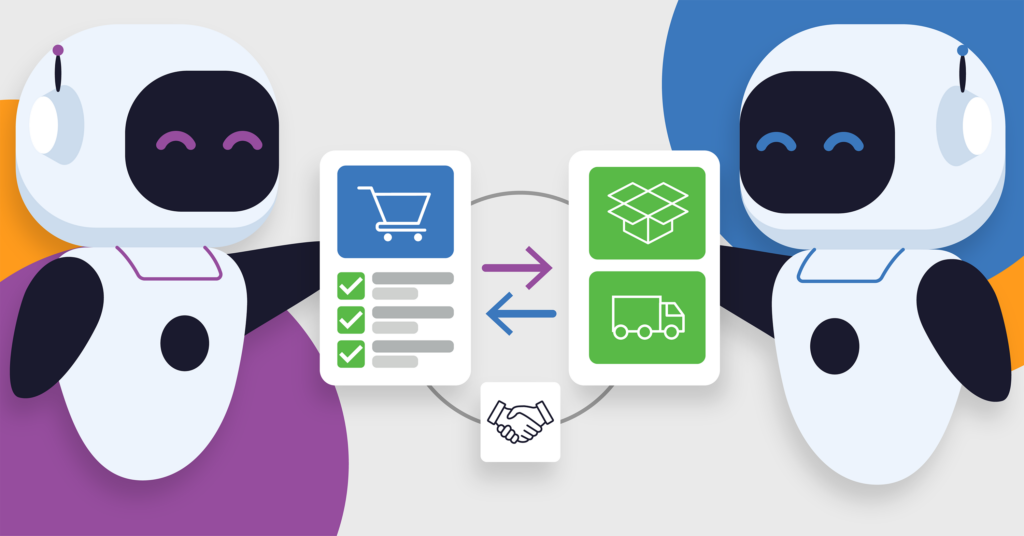
- AI agents are increasingly participating in B2B purchasing by comparing vendors, evaluating pricing, and supporting negotiations.
- For vendors, providing clear, consistent information that can be readily interpreted by AI agents will be important to staying competitive.
- As the prevalence of agentic AI commerce increases, B2B go-to-market (GTM) strategies will need to account for buyers who may never interact directly with a salesperson.
Your next buyer might not be human.
For years, B2B marketers have focused on reaching the right decision-makers, building relationships, and moving prospects through the sales funnel. But what would need to change if your first customer interactions aren’t with people?
AI agents are starting to take on tasks that traditionally belonged to (human) buyers and procurement teams. Agents are not only researching solutions but also comparing vendors, evaluating commercial terms, and even participating in price negotiations.
According to IDC, 80% of B2B technology buyers already use AI agents to assist with or perform buying tasks.1 Forrester predicted that 20% of B2B sellers would be forced to engage in agent-led quote negotiations in 2026, responding to AI-powered buyer agents with counteroffers delivered through seller-controlled agents.2
In other words, AI agents are not just generating a few recommendations for what tech products to buy. They are becoming active participants in the purchasing transaction. That participation introduces some new challenges for B2B go-to-market (GTM) teams.
Understanding the Agent-Led Buying Process
Let’s say a company is evaluating a new cloud infrastructure provider. In the past, a procurement specialist might have conducted research and then gathered quotes from five vendors. Today, the company assigns an AI agent to do that initial work. Specifically, the agent first identifies potential providers, then compares technical specifications. It can check pricing, evaluate service agreements, and then request quotes based on specific requirements.
The process is fairly similar in both cases. But the AI agent can get to the quote request stage in a matter of minutes, instead of the hours it might take a human procurement specialist.
When quotes are received, the buyer’s agent can then continue its accelerated process. The agent can start negotiating, using predefined budget limits, and then ultimately present the best options to a human decision-maker.
If it works as advertised, the process can be extremely efficient. But of course, there could be snags for both sides. For example, what happens when the AI agent can’t readily find the information it needs? It might simply move on to another vendor—one that can provide the quote as quickly as the agent generated the request.
Preparing Product Information for Bots
Just like the human buyers of the past, your new AI agent buyers expect accurate, real-time information for pricing, promotions, inventory availability, and delivery estimates.3
But the agents don’t need this information presented to them in the same way as their human colleagues. The humans, for example, might want to see a visually compelling sales presentation or an engaging, well-designed website. The agents? They just want the information. It doesn’t have to look fancy.
This shift in buyers, then, creates some interesting challenges for the technology companies offering the solutions. Currently, many B2B websites are designed to generate conversations. Instead of providing complete answers or comprehensive product information, these sites are meant to trigger interest and then drive human buyers to connect with the sales team.
Agents have trouble finding what they need on these sites, though. According to Siteline research, AI agents frequently struggle to retrieve pricing and packaging information from B2B software websites.4 And these agents aren’t patient. Developed to deliver fast results no matter what, agents might not take the time to navigate multiple web pages, download brochures, or fill out a form just to understand basic pricing. Instead, they’ll just move on to another vendor.
Given the rising importance of this agent-led buying process, technology companies might need to rethink their website design. Instead of spending an inordinate amount of time creating pages meant to spark interest, entice further exploration of additional assets, and then ultimately generate sales meetings, organizations might need to provide more straightforward sites that can efficiently deliver information to machines.
Rethinking the GTM Model
Beyond merely optimizing website design, organizations should also re-evaluate additional aspects of their GTM model. For example, product marketing teams should ensure that the product information they are presenting—not only on the website but across every asset and communication—can be accurately interpreted by AI. In addition, organizations should ensure that their pricing strategies are clear and consistent, from initial agentic AI inquiries through final negotiations.
Moreover, the sales team might need to take a different approach to closing the deal. These team members might have human-to-human conversations only much later in the buying process, after a customer’s agent has already evaluated competing offers. At that point, the human sellers might find less room for negotiation.
Relationships and sales expertise will continue to be important in selling. Complex B2B purchases still require human buyers, and those buyers will want to trust and have confidence in sellers. But the work before the sale might need to change significantly to accommodate this new audience of AI agents. Marketing and sales will need to refocus different new moments in the buyer’s journey where they will have the greatest influence.
Making It Easier to Buy from Your Business
For years, B2B marketing focused on getting buyers to find their businesses. The introduction of AI search subtly changed the objective, driving organizations to concentrate on ways to have AI recognize and recommend their business and their products. Now agentic buying is challenging organizations to make it simpler for agents to evaluate and transact with their business.
A move to agent-only commerce is unlikely to happen soon. But there’s no question that buyers are increasingly exploring ways to use agents for the first parts of the buying process—and that shift means vendors need to adapt or they will be at a competitive disadvantage.
For the time being, many B2B companies will need to build their GTM strategies simultaneously for two audiences: the AI agents helping to narrow the field and the humans ultimately making the final purchasing decisions.
A: Organizations are increasingly using AI agents not only to conduct initial vendor and product research but also to compare vendors, evaluate terms, and participate in price negotiations. Though agent-only purchases are still a ways off, agents are doing more of the work before the final purchasing decision.
A: To accommodate AI agents in the purchasing process, vendors need to ensure that product information and pricing are clear, consistent, and easily consumed by agents across every channel, including the website. They might also need to adjust how sales team members approach discussions with customers, since those discussions will occur later in the process.
A: No, technology companies should not completely replace existing websites and digital assets designed for humans. However, as agentic AI becomes more prominent for buying, these companies might need to find ways to speak to two audiences at once: both humans and agents.
- IDC, The CMO’s buyer alignment blueprint, December 2025
- Forrester, Forrester’s 2026 B2B Marketing, Sales, And Product Predictions, October 2025
- Mirakl, Top AI 5 trends Reshaping B2B commerce in 2026, January 2026
- Siteline, How well do AI agents understand top software products? An in depth benchmark analysis, June 2026
