Your marketing group just signed up for an AI tool that scrapes customer data. Your sales team is feeding proprietary deal terms into ChatGPT. Your developers are using AI coding assistants that may be training on your intellectual property. And your procurement team? They just approved three new SaaS contracts with “AI-powered features” buried in the fine print.
None of them asked permission. Most of them don’t know what data is leaving your network. And you’re just finding out now.
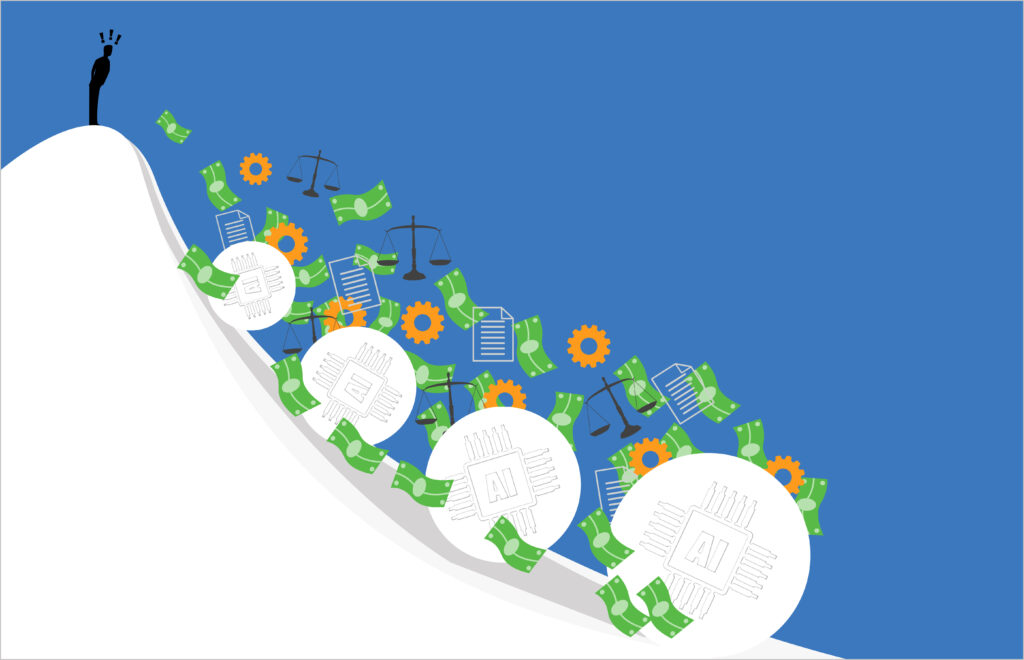
This is the AI snowball effect in action: what starts as one team experimenting with a helpful tool quickly multiplies across departments, gathering momentum, complexity, and risk with each adoption. Before leadership can establish oversight, the organization is already cascading toward serious security, compliance, and financial exposure.
For CIOs and CISOs, this isn’t a future threat—it’s happening right now, and the window to get ahead of it is closing fast.
The Snowball Is Rolling: Adoption Is Exploding
The latest research shows that 78% of organizations now use AI in at least one business function, up dramatically from just 55% a couple of years ago.1 Many enterprises aren’t just experimenting: 23% report they’re scaling “agentic AI systems” in at least one business function, with 39% experimenting with AI agents overall.2 According to a 2025 enterprise-AI adoption report, by now 31% of prioritized AI use cases have reached full production, double the share from the prior year.3
This is no longer early-stage exploration. AI is moving fast, and fast becomes permanent if not managed.
The AI explosion isn’t happening through neat roadmaps and approved rollouts. It’s seeping in through the cracks. IBM’s latest Cost of a Data Breach Report shows that while only 13% of organizations have reported an AI-related breach so far, 97% of those breached lacked proper AI access controls, with most incidents originating in compromised apps, APIs, or plug-ins across the AI supply chain.4
What’s Feeding the Snowball
Runaway AI isn’t fueled by ambition alone. It’s powered by embedded tools, unchecked identities, and costs that compound out of sight.
Three forces are expanding your risk surface at the same time:
Embedded AI is everywhere
AI isn’t a separate category anymore. It’s baked into your existing SaaS tools, vendor platforms, and third-party services. Your team didn’t “adopt AI.” They renewed a software contract that now includes it. Every vendor update, every feature flag turned on, every unsanctioned tool quietly expands your perimeter.
Unchecked machine identities
Bots, API keys, service accounts, AI agents—each one is a potential entry point, and most organizations have lost count. In many enterprises, machine identities now outnumber human users,5 and only a fraction of organizations have full visibility into all identities (human and machine) operating in their environment. What starts as a convenient integration becomes a sprawling, unmonitored liability.
Cost are compounded by invisibility
AI doesn’t just threaten your security posture. It’s bleeding your budget. More agents, more API calls, more model usage, more storage. Because AI grows incrementally across departments, finance doesn’t see it coming until the bill arrives and systems start buckling under the load.
Without guardrails, runaway AI becomes a runaway cost center.
The Hidden Dangers: What Happens When the Snowball Hits
When ungoverned AI proliferation reaches critical mass, the consequences aren’t abstract. They’re operational, financial, and reputational. Here’s what IT leaders are already dealing with:
- Identity as the weakest link. Every AI agent, API key, and service account is a potential breach vector. With machine identities now outnumbering human users in many enterprises, traditional identity and access management systems weren’t built for this scale. One compromised bot account can move laterally through systems faster than your security team can detect it.
- Vendor’s problem becomes your crisis. When critical AI capabilities live in third-party platforms, you inherit their security posture whether you like it or not. A breach at your AI vendor doesn’t just affect their customers—it cascades through your operations, exposing your data, disrupting your services, and putting your brand at risk while you have zero control over the response.
- Bad data means bad decisions. AI agents and models are now touching everything from customer analytics to financial forecasting. When those outputs are hallucinated, biased, or trained on corrupted data, the errors don’t stay contained. They flow into executive dashboards, investor presentations, and strategic decisions. By the time someone notices, the damage is done.
- You can’t comply with what you can’t see. GDPR requires you to document data processing activities. CCPA demands you honor deletion requests. SOC 2 audits need proof of access controls. But when shadow AI tools are spinning up across departments without IT oversight, you’re building a compliance gap you won’t discover until the auditor asks questions you can’t answer. And regulators don’t accept “we didn’t know it was there” as a defense. The financial impact is already real: 20% of organizations suffered breaches tied to unsanctioned, shadow AI use, adding an average of $670,000 per incident.6
- Your CFO gets an ugly surprise. AI costs don’t show up in neat line items. They’re scattered across departmental budgets, buried in SaaS overages, hidden in cloud compute bills. Token usage compounds, redundant tools overlap, and unapproved integrations rack up charges—all invisible until the quarterly review when finance demands to know why spending spiked 40%.
This isn’t a risk assessment for future planning. This is what’s already happening in organizations that let the snowball roll unchecked.
The Gap Between Excitement and Governance
Every executive wants AI’s upside. Few are prepared for its downside.
The difference comes down to strategy: organizations with visible AI strategies are twice as likely to drive revenue growth from AI and 3.5 times more likely to realize critical business benefits than those relying on informal or ad hoc adoption.7 That’s not a marginal edge—it’s the difference between intentional scale and uncontrolled sprawl.
But this isn’t just about execution. It’s about recognition. Most leadership teams still view AI through a single lens, as a productivity multiplier, a competitive advantage, an innovation accelerator. What they’re missing is that AI is also an identity management crisis, a data governance nightmare, a compliance minefield, and a budget black hole, all happening simultaneously.
The enthusiasm is real. The guardrails aren’t. And that mismatch is creating exactly the conditions for the snowball effect to accelerate: everyone wants to move fast, no one wants to be the person who slows things down, and by the time the risks become visible, they’re already embedded in operations.
The question isn’t whether your organization will adopt AI. It’s whether you’ll govern it before it governs you.
Why CIOs and CISOs Need to Act… Now
If you’re reading this, you already know something is wrong. You’ve seen the signs: surprise vendor invoices, security tools flagging unknown API calls, compliance questions you can’t answer, budget conversations where “AI costs” are a black box.
The snowball is already rolling. The question is whether you can stop it before it becomes an avalanche.
This isn’t about being anti-innovation. It’s about making innovation sustainable. Here’s what governance looks like in practice:
- Get full visibility. You can’t govern what you can’t see. Map every AI endpoint, vendor integration, agent, and machine identity operating in your environment. Not just the ones IT approved… all of them. This is a discovery problem first, a policy problem second.
- Treat machines like employees. Machine identities—API keys, service accounts, bots, agents—need the same lifecycle management as human users: provisioning, monitoring, rotation, and decommissioning. If you wouldn’t let an employee keep their access credentials forever, why would you let a bot?
- Build guardrails, not roadblocks. Policies without enforcement are just suggestions. Implement vendor governance frameworks, access controls, data handling standards, and approval workflows that actually stop unauthorized deployments before they go live. Make it easier to do the right thing than to work around the rules.
- Make AI costs visible. If finance can’t track it, they can’t control it. Establish cost accountability at the team level, implement usage monitoring, and create approval thresholds for AI spending. The CFO should never be surprised by an AI bill again.
- Audit before it matters. Don’t wait for bad data to reach the boardroom. Implement validation checks on AI outputs, document data lineage, and establish review processes for any AI-generated content that feeds into decisions, reports, or customer-facing systems.
The window is closing. Every day without governance is another day the snowball picks up speed, gathers mass, and becomes exponentially harder to stop. The organizations that act now will control their AI future. The ones that wait will be controlled by it.
The Snowball Is Rolling. Will You Be Bowled Over?
The AI transformation isn’t coming. It’s already inside your network. Vendors, SaaS tools, departments, bots, agents. They’re multiplying right now, whether you’re tracking them or not.
What you do next determines everything.
Build the guardrails. Create visibility. Establish accountability.
Because the alternative isn’t gradual risk or manageable exposure.
It’s an avalanche that buries your security posture, your compliance program, and your budget—all at once.
The snowball is rolling. The only question is whether you’ll stop it or get swept away.
- Stanford University HAI, Artificial Intelligence Index Report 2025, accessed December 2025
- McKinsey, The State of AI in 2025, Agents, innovation, and transformation, November 2025
- ISG, State of Enterprise Adoption Report, September 2025
- IBM, Cost of a Data Breach Report 2025, July 2025
- CyberArk, Machine Identities Outnumber Humans by More Than 80 to 1, April 2025
- IBM, Cost of a Data Breach Report 2025, July 2025
- Thomson Reuters, Future of Professionals Report 2025, July 2025
