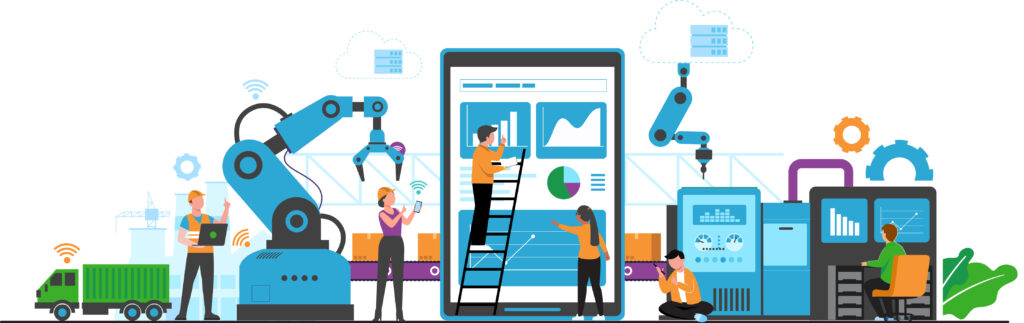
Digital transformation in the industrial sector requires organizations to bring together two unique and long-siloed technology stacks: information technology (IT) and operational technology (OT) systems.
Traditionally, industrial organizations have used IT systems to power use cases such as data analytics, customer relationship management platforms, inventory systems, and other business-critical tools. OT, on the other hand, has been employed to manage and control plant-floor equipment through technologies such as PLCs and SCADA systems.
Uniting these two disparate sides of the house is essential to enabling the smart factory model. By bringing them together into a single, converged architecture, modern manufacturers are realizing efficiency, profitability, and safety gains that help their organization stand apart from the crowd.
IT/OT convergence has played a key role in the emergence of the Industrial Internet of Things (IIOT) and Industry 4.0. And its prevalence is only growing. Analysts predict that the use of converged technologies for greenfield projects will rise to approximately 50 percent by 2029.1 And between 2025-2030, the market for IT/OT convergence has been forecasted to grow at a CAGR of around 21%.2
Connecting the Digital and the Physical
Traditionally, manufacturing equipment has been connected to local, OT-based control and automation systems, but kept isolated from the IT capabilities that power business analytics and decision-making. For example, a piece of plant floor equipment may have been integrated with other machinery through proprietary OT connectivity but was not connected to IT systems via the LAN.
The extension of edge compute resources—like edge servers on the plant floor—and the integration of various types of sensors have enabled OT equipment to be connected, monitored, and even controlled through IT systems. Because factory equipment often only supports specific types of connectivity, networking devices known as industrial gateways are deployed to bring together communications from a variety of network protocols.
With IT and OT systems integrated at the edge, it’s easy for organizations to connect factory operational data with cloud and data center resources or applications as needed. Advanced use cases can even apply intelligent automation to factory equipment, enabled by the steady stream of real-time factory data and powerful analytics or AI tools.
How Manufacturers Benefit
What happens when IT and OT come together? Connecting them enables organizations to maximize efficiency, productivity, safety, and profitability. These optimizations are made possible by deeper insights into plant floor operations. Factory sensors and connected equipment can provide rich information for business planning and optimization tools, allowing teams to make more informed and strategic decisions about their operations. Staff can more easily spot bottlenecks, understand capacity, flag potential safety issues, and optimize for productivity. Additionally, the abundance of data can be used to fuel analytics engines and AI tools that enable capabilities such as proactive and predictive maintenance.
Taking full advantage of the data unlocked by IT/OT convergence, organizations can even create digital twins of their manufacturing environments—giving staff a complete view of what’s happening throughout their operation and allowing them to simulate the impact of changes in a virtual environment.
The Challenges of IT/OT Convergence
IT/OT integration presents several unique challenges to manufacturers. For starters, because of the time-sensitive nature of industrial applications, manufacturers may need to deploy specialized networking and time-sensitive compute capabilities that help them avoid latency or subpar performance for mission-critical use cases.
Additionally, since IT/OT convergence connects IT systems to physical plant equipment, it amplifies the need for stringent cybersecurity. In a converged environment, compromised IT systems could lead to significant factory downtime and safety issues. Organizations need to ensure they have adequate security protections in place as they bring together IT and OT. Proper data governance, management, and integration are also essential to ensuring organizations can get the most value out of their connected manufacturing operations.
Complicating matters, many factories still use aging legacy OT systems that can be difficult to connect to modern infrastructure. In environments with a large amount of this legacy gear, a phased approach to transformation can help make the required evolution possible. Industrial gateways can also help connect these devices in a cost-efficient manner.
Another challenge is that manufacturing sites are often harsh environments that subject equipment to heat, vibration, dust, and other hazards. As a result, all off the IT equipment being integrated into these environments needs to be ruggedized so it’s up to the task of operating among the challenging conditions.
Finally, finding personnel with combined IT/OT expertise can be difficult, which requires many organizations to pursue ways to upskill and build proficiency among their current team.
The Era of Smart Factories Is Just Beginning
As manufacturers race to realize a competitive edge through digital technologies, IT/OT convergence represents an essential first step. Bringing together IT and OT, industrial organizations can realize connected and data-driven capabilities that create sizable gains in visibility, efficiency, and safety. After all, when silos fall, innovation often follows—and that’s exactly the case for today’s manufacturers.
- BCG, Converging IT and OT Will Boost Value in Industrial Tech, June 2024
- Virtue Market Research, IT/OT Convergence Market Research Report, April 2025
