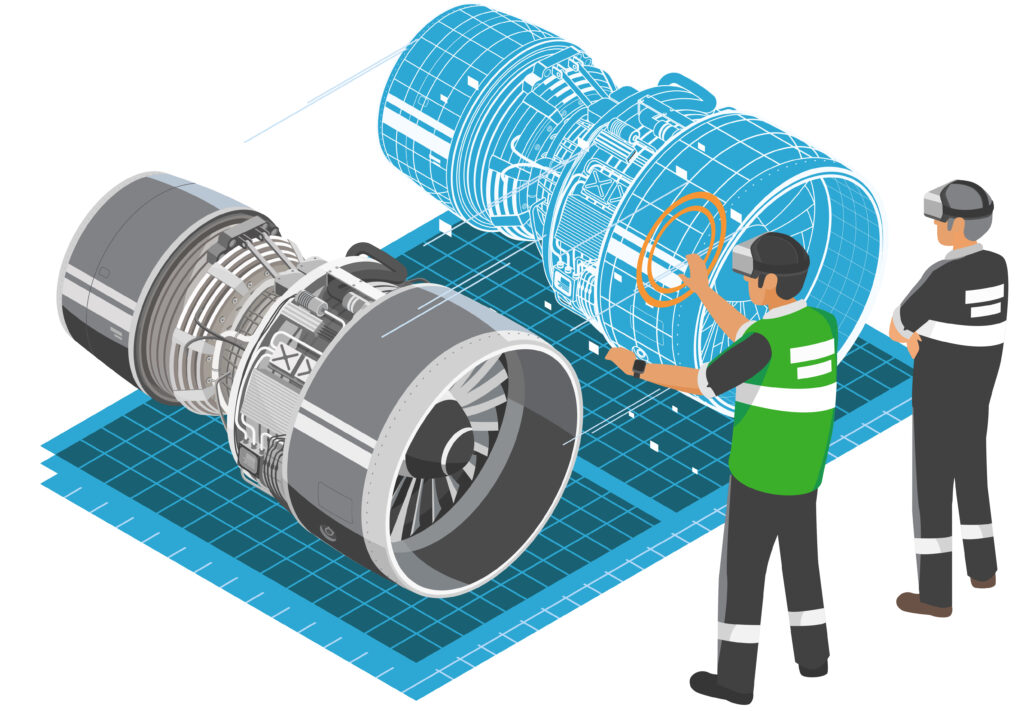
Digital twins are virtual replicas of real-world systems that provide organizations with rich tools for experimentation, planning, optimization, and risk mitigation. Enabled by IoT sensors and IT/OT convergence, these simulations mirror their counterparts in a true-to-life fashion, with data flowing in real time from the physical location to its digital representation. Through digital twins, teams can explore scenarios, experiment with variables, and investigate the current status or performance of the connected system.
In today’s increasingly complex landscape, digital twin technologies have emerged as important tools for staying informed about conditions, preventing problems, and optimizing operations. By 2029, 95% of all IoT platforms will include some sort of digital twin capability.1 Unsurprisingly, economic activity around them is expanding to match. Gartner estimates that by 2034, the digital twin market will reach $379 billion—up from $35 billion in 2024.2
What’s driving this rapid growth? For starters, implementation barriers are falling. Deloitte reports that many organizations now have the essential building blocks of a digital twin solution in place, including cloud computing adoption and the deployment of IoT devices and sensors.3
Another key factor is that while digital twin capabilities are primarily used in the industrial and manufacturing sectors, many other domains are beginning to take advantage of them. Across industries, innovative new applications of digital twin technologies include:
- Simulating patient-specific physiology to enable personalized care and improved outcomes
- Exploring the impact of different store layouts to identify potential problems and their likely effect on shopper behavior
- Modeling and optimizing city elements such as traffic flow, energy grids, and water management to improve sustainability and maximize efficiency
- Connecting with building information systems to deliver deeper visibility into conditions and enable improvements to the tenant experience
AI Is Supercharging Digital Twin Evolution
Like almost every other aspect of the modern technology landscape, digital twins are being impacted heavily by AI. For example, large language models (LLMs) accelerate the development of digital twin software through code generation—and allow users to interact with digital twins in production via natural language commands, which greatly streamlines processes and accelerates outcomes. Teams also use LLMs as tools to help identify new scenarios to test, suggest additional variables to tweak, analyze complex problems, or further understand the results of a simulation.
These examples serve to illustrate the fact that AI’s impact on digital twins is holistic and pervasive, with a considerable effect on how they’re built, how they’re used, and what they can do.
Beyond LLMs, a wide range of other AI technologies play key roles in enabling digital twin solutions. Generative AI creates synthetic training data for digital twin models. Advanced AI physics models such as physics-informed neural networks significantly speed processing times for simulations, allowing for real-time scenario testing. Machine learning algorithms help identify patterns and trends while enabling self-learning capabilities to improve areas like predictive maintenance, energy usage optimization, or adaptation to supply chain issues. Digital twins even play a role in enabling AI-powered robotics and autonomous vehicles, where they’re deployed as virtual sandboxes for training.
The Rise of Digital Twin as a Service Offerings
While AI continues to expand what’s possible with digital twins, it’s also becoming easier for organizations of all sizes to create and implement them. Digital twin as a service (DTaaS) offerings such as AWS IoT Twinmaker and Azure Digital Twins provide streamlined on-ramps to simulation capabilities through subscription-based pricing that doesn’t require hardware investments. These services deliver cloud-native digital twin capabilities that allow customers to start small and scale up as needed. The DTaaS market is expected to be worth around $397 billion by 2033.4
Expanding Possibilities Through Interoperability
Alongside becoming more widespread and accessible, digital twins are also becoming more interoperable and standardized. While early digital twin deployments were often fragmented and based on proprietary models and protocols, recent years have seen a number of new standards introduced in the industry, including ISO 23247, a reference architecture standard for creating interoperable digital twins in manufacturing, and the Digital Twin Definition Language (DTDL), a modeling language for consistent, machine-readable twin models. Additionally, frameworks such as OPC Unified Architecture enable standardized data exchange and connectivity across industrial IoT devices and asset networks.
These advancements in standardization position the industry for greater interoperability between vendors, enabling reduced vendor lock-in, faster scaling, and richer analytics. Additionally, standards play an important role in allowing organizations to connect numerous digital twins to enable comprehensive, enterprise-wide, real-time simulations. They’re also essential to an emerging use case known as federated digital twins, where multiple organizations combine simulations to form a centralized, shared model. This capability will be particularly useful in areas where tight inter-organizational collaboration is critical, such as logistics or utilities.
What’s Next for Digital Twins?
Industry 5.0 places a heavy emphasis on more natural and intuitive relationships between humans and machines, which positions digital twins to become even more essential to optimizing performance, ensuring visibility, maximizing efficiency, and minimizing risks.5
With AI capabilities continuing to change the game, DTaaS lowering barriers to entry, and increasing interoperability across technologies, digital twins will only become more ubiquitous and powerful as the lines between the physical and virtual worlds blur. Whether they’re modeling factory operations, a retail store, the human body, or an entire city, digital twins are poised to continue delivering a sustained and dramatic impact on the real world.
- Research and Markets, Digital Twins Market by Technology, Twinning Type, Cyber-to-Physical Solutions, Use Cases and Applications in Industry Verticals 2024 – 2029, June 2024
- Gartner, Emerging Tech: Revenue Opportunity Projection of Simulation Digital Twins, May 2024
- Deloitte, From manufacturing to medicine: How digital twins can unlock new industry advantages, June 2025
- Market.us, Global Digital Twins-as-a-Service (DTaS) Market, April 2024
- McKesson, Human-centric manufacturing, April 2023
