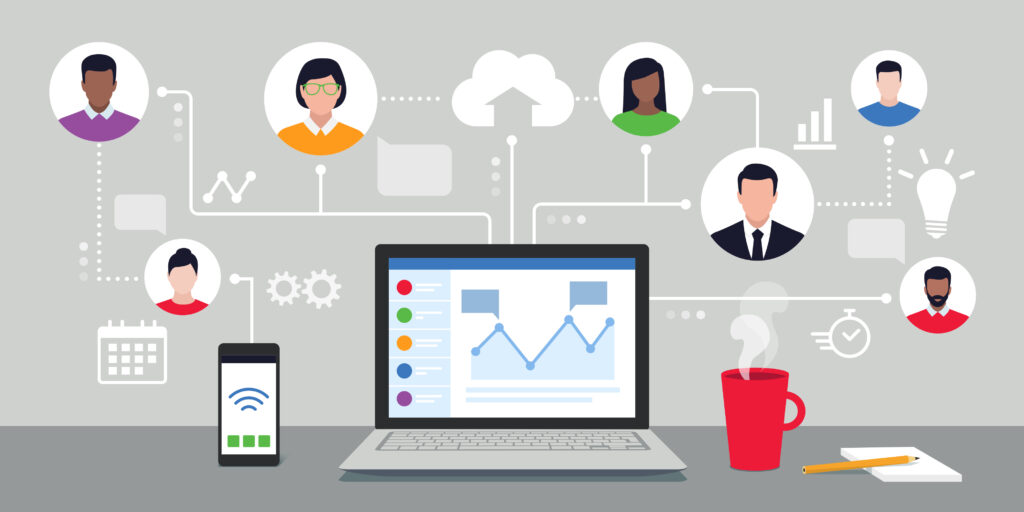
- Return-to-office (RTO) mandates are on the rise as leaders attempt to increase worker productivity, collaboration, and accountability.
- Before altering remote work policies, leaders should address issues that can impact work from any location.
- Following a few key principles can help organizations optimize work whether employees work from home or a corporate office.
Organizations across industries are implementing return-to-office (RTO) mandates—requiring employees to work from corporate locations at least part of the time. According to one recent report, 55% of surveyed companies now have employees working from the office three to four days per week—up from 36% the previous year.1 By bringing teams together after years of remote work, company leaders intend to boost productivity, facilitate collaboration, and strengthen accountability.
For some organizations, this RTO push might be the right move. After all, some types of tasks—like creative brainstorming or mentoring—can benefit from in-person interactions.
But for many organizations, RTO mandates are attempts to address challenges that were never related to employee location. Organizations that had difficulty with productivity, collaboration, or accountability during the remote work era might continue to face those issues when putting everyone in the same building.
How can organizations optimize work—without requiring employees to return to corporate offices? A few key principles can help organizations achieve workforce goals whether employees continue working from home or commute to an office.
Acknowledge the Diversity of Remote Work
“Remote work” does not look the same for every organization. Some might have fully distributed teams with no shared office and no clearly defined working hours. Others might take a hybrid approach, with employees working from an office two or three days per week. Some might enable employees to work from home but apply the same expectations as onsite work, with very specific start and end times, for example. And of course, some organizations might adopt multiple remote work models, with policies differing according to job roles or geographic location.
Lumping all of these models together under the single category of remote work—and then drawing conclusions about the effectiveness of that remote work—will not lead to sound decisions. Instead, leaders must recognize that each version of remote work should be evaluated separately. A fully remote team with precise communication rhythms, clear output expectations, and real accountability infrastructure can outperform a hybrid team that treats office days as social events and home days as catch-up time.
Before any leadership team decides to change their organization’s existing work model, they should consider asking: Which versions of remote work are meeting our goals? And do we have the right structures and tools in place to support the models we already have in place?
Create Structure
For employees, working from home offers tremendous flexibility. Depending on their organization’s policies, they might be able to set their own start and end times, establish their own dress code, play whatever music motivates them, and run that occasional errand in the middle of the day without asking a manager for permission.
It might sound great, but not all individuals thrive in an environment with complete flexibility.
Compare that work-from-home experience to working in an office. An employee might begin with a commute—timed just right to avoid traffic or to catch a particular train. At the office, the employee swipes a badge to enter, fills a coffee mug, greets colleagues, and sits down at their work desk by a certain time.
These steps are not just habits. They are transition rituals that separate personal time from professional time.
Some remote workers create their own transition rituals. But working from home can nevertheless blur the distinction between personal and professional time—and for some employees, that lack of clear separation impacts productivity.
Employers can help workers focus on work, even from potentially distracting home environments, by creating some structure. Establishing start and end times (even with a little wiggle room), setting weekly team meetings, and requiring periodic email or video check-ins with managers can all help employees regain some of the structure they often lose when working from home. As a result, they can better distinguish work time from personal time—and better focus on work tasks during their working hours.
Build Processes to Ensure Accountability
Remote work exposed a problem that always existed in offices too: Most teams do not have an effective process for moving work from the initial assignment all the way through completion. In an office, process gaps might be addressed by hallway check-ins. But if organizations remove the shared hallway, those process gaps can quickly become real problems.
Fortunately, there are numerous tools that can help remote teams—as well as hybrid and in-office teams—effectively manage workflows. Adopting a project management platform, task tracking system, or shared dashboard can go a long way toward eliminating gaps. Organizations just need to ensure that team members actually use the tool, regardless of where they are sitting.
When processes are in place—and managed with a single tool—organizations can improve accountability. Managers know who is responsible for each task, and each employee knows their role. Maintaining that accountability is essential for completing work, especially when hallway check-ins are not possible.
Measure What Is Actually Completed
Some enterprises have established policies designed to confirm that employees are working when they say they are. These organizations might monitor keystrokes, require cameras to be on during calls, or check to make sure employees are shown as “available” on chat platforms.
None of these tactics measure whether work is getting done. They only measure whether people are performing some work-like actions—and that’s not a particularly useful metric.
Instead, leadership teams should stay focused on the real goal: getting stuff done. First, they should define what “done” looks like. It might be published articles or newly acquired customers. Then they can more effectively manage that output, helping team members achieve set goals, no matter how many keystrokes employees are logging in the process.
When leaders focus on activity (those work-like actions), they will likely feel more comfortable when they can see their direct reports in the office. But when they focus on output, location becomes almost irrelevant.
Pay Attention to Sustainability
Whether organizations enable employees to work from home, implement hybrid work policies, or require individuals to return to offices, leadership teams must make sustainability a high priority. Burnout can happen anywhere. Clearly defining output expectations and maintaining consistent communication strongly contribute to worker satisfaction and loyalty. Moreover, helping to ensure that employees can separate from work—at home or in the office—is crucial to boosting productivity and preventing churn.
Finally, leaders should also encourage employees to truly unplug when they take earned time off while also finding opportunities to momentarily de-stress throughout the work week. National Relaxation Day (August 15) reminds us all that rest and recovery are genuinely important for building the strength and resilience to do our best work—wherever we are located.
A: Leadership teams believe that bringing people back to corporate offices after years of remote work policies can help boost productivity, facilitate collaboration, and improve accountability. According to a recent report from the commercial real estate services firm JLL, 55% of surveyed companies now have employees working from an office three to four days per week.1
A: While bringing employees together in a single space might make sense for some organizations or some teams, many organizations first need to address productivity, collaboration, and accountability issues that can appear no matter where employees are located.
A: A few key principles enable organizations to optimize work, wherever it is done. After recognizing that not all remote work is the same, leaders should help create structure for employees, focus on employee output (not activity), build processes that ensure accountability, and encourage employees to take time to relax and unplug.
- JLL, Global Occupancy Planning Benchmark Report 2026, May 2026
