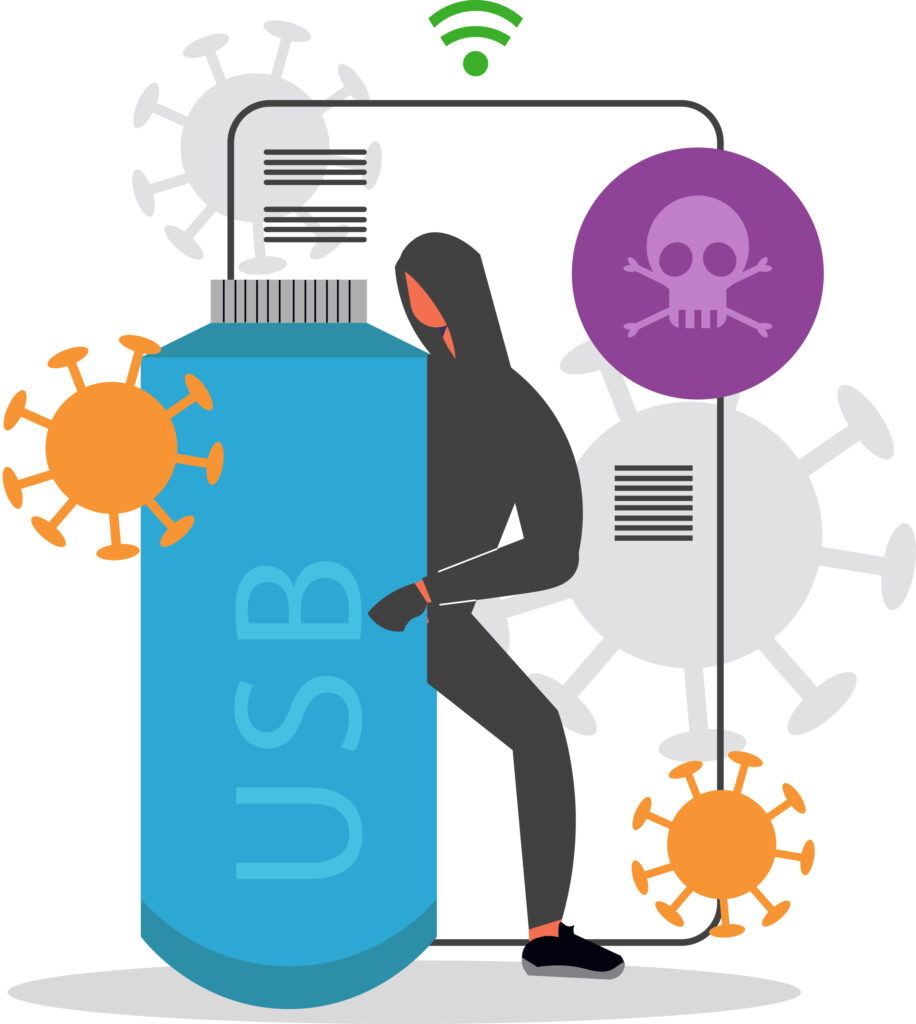
It’s a well-known fact of digital hygiene practices, and perhaps just everyday common sense, that random USB drives deserve a healthy level of suspicion. These tiny storage devices can execute malicious code, log keystrokes for later password retrieval, or even spike voltage in the target system to disable it permanently. One enterprising individual even created a USB drive that exploded with confetti shortly after being plugged in. There are seemingly no limits to what a USB drive can do, and why everyone needs to think twice before plugging one into their endpoint or server.
But there’s a hitch. The U in USB stands for universal, and nearly every system has USB ports to allow interfacing between devices for maintenance or everyday use. The vulnerability will always exist. Ethical hackers and bad actors are getting increasingly creative in how they can trick end users into compromising their own USB ports, while enhancing the capabilities of whatever gets plugged into the port itself.
Cottonmouths and Chameleons
In 2013, publication of the leaked NSA Advanced Network Technology (ANT) catalog revealed the Cottonmouth, a USB Type-A cable that could deploy a trojan horse to an exposed system.1 Each cable cost approximately US$20,000, and the fact that the Cottonmouth was disguised as a cable and not a thumb drive added to its notoriety. Everyone knows not to plug in a random thumb drive found in a parking lot, but most end users don’t expect cables to be loaded with malware. Cables transmit data, they don’t store data themselves.
Fast forward a decade and time has been good to technology and rude to everyone else. The modern equivalent of the Cottonmouth, the O.MG Cable, is available off the shelf for a mere US$200 and can do so much more. The O.MG Cable features a hidden Wi-Fi controller that allows an attacker to wirelessly connect to a compromised system for continued access. This connection isn’t particularly strong, offering a maximum range of 30 feet per one source.2 But it also doesn’t have to be very strong because the O.MG Cable can grab Wi-Fi credentials from the compromised device and connect to an official Wi-Fi network all on its own.
The O.MG Cable is a chameleon, available in USB Type-A and Type-C varieties, Apple Lightning, as well as extenders and adapters. They look exactly like a run-of-the-mill cable that everyday people use to charge their phones or connect peripherals to their PCs. When plugged in, the O.MG Cable tells the compromised device that it’s a keyboard and can inject keystrokes at a rate of 120/second, or up to 890/second for premium versions. While it’s doing this, the cable will still transmit data and power normally, leaving the victim unaware that anything is amiss. A built-in self-destruct feature can block data transmission and trick the victim into throwing away the presumably faulty cable, which helps cover the attacker’s tracks.
It’s also worth noting that Mike Grover, the inventor of the O.MG Cable, is the same guy who created the exploding USB drive mentioned previously. He certainly likes to make a bang.
A Red Team’s Best Friend
At 99% less cost than the Cottonmouth and with infinite more utility, the O.MG Cable is a very scary device. U.S. Department of Defense (DoD) red team contractors used the cable to infiltrate a government server room and maintained clandestine access to systems for six months.3 The exercise only ended when the contract elapsed, but the cable was never discovered. It should be noted that the red team initially gained access to the server room by posing as Xfinity technicians following up on a connectivity issue, but the O.MG Cable persisted through several sweeps and internal security mechanisms, including weekly server data wipes.
In a similar story, another red team used an O.MG Cable-integrated external hard drive to compromise an air-gapped laptop in a digital forensics lab.4 The red team used the laptop to access to the lab’s storage area network (SAN) and activated a public internet connection from the laptop itself. This meant they could exfiltrate and manipulate data at will in this supposedly locked-tight facility that’s responsible for examining evidence in criminal prosecutions. In this scenario, the red team posed as a courier service, and they merely dropped the O.MG drive off at the front counter.
The USB Ports on Pandora’s Box
Whereas the Cottonmouth was a spy tool used by a spy agency, the O.MG Cable is cheap, commercially available, and ubiquitous in the cybersecurity world. One could argue that its creation was inevitable, given the implementation is actually quite simple: a Wi-Fi controller and antenna hidden inside the cable’s connector housing. The question is, now that Pandora’s Box has been opened, how can organizations deal with all the fun stuff slithering out of it?
Effective countermeasures largely boil down to looking at USB cables with the same suspicion as people apply to USB drives. Every connector housing might contain a firecracker, every port can be a potential entry point. Beyond that, an organization that wants to protect itself from O.MG Cables needs to focus on locking down their physical environments and training up their staff. In the red team scenarios described previously, the initial infiltration depended largely on social engineering techniques to gain access to on-premises systems. The fact that the O.MG Cable is so well disguised is what allowed it to stay in play, so prevention is the best defense against an O.MG Cable turning into an OMG security breach.
- Ars Technica, Your USB cable, the spy: Inside the NSA’s catalog of surveillance magic, December 2013.
- Linus Tech Tips, I wouldn’t give this cable to my worst enemy – O.MG Cable, May 2023.
- Darknet Diaries, EP 161: MG, July 2025.
- Ibid.
